1.Introduction
LONGi Green Energy Technology
Co, Ltd? entered into a global,
non-exclusive, cross-licensing agreement with Shin-Etsu Chemical Co, Ltd on
March 25, 2020. As a result of the agreement, any application of LONGi products
that relates to Gallium-doped technology will be permitted legally on a global
basis. Gallium-doped silicon can effectively solve LID (Light induced
degradation) in a ?P-type PERC module.
LONGi already addressed the problem of the high cost of Gallium-doped silicon through
its own technological efforts and will therefore now be able to provide this for
the whole PV industry. At the same time, LONGi commits to the price of
Gallium-doped silicon being the same as that for Boron-doped silicon, which
will further help PV become the most cost-effective method of power generation.
2.Literature
review of Gallium-doped and Boron-doped silicon
Today’s industry-standard Boron-doped
monocrystalline silicon still suffers from LID over its lifetime. Industrial
Czochralski (Cz) silicon contains significant amounts of interstitial oxygen
which, in combination with Boron-doping, can result in LID and, in turn, affect
cell efficiency. To our knowledge, the first observation of LID in non-particle-irradiated
solar cells fabricated on boron-doped Cz-Si wafers was made by Fischer and
Pschunder in 1973 [1]. They recorded a strong degradation of short-circuit
current and open-circuit voltage during the first hours of illumination until a
stable level was reached. Interestingly, the initial cell performance could be
completely recovered by a low temperature anneal at only 200°C. Additional photoconductance decay
measurements indicated that the observed effect was due to a bulk carrier
lifetime varying between two levels, corresponding to two different states of
the material, A and B. State A is associated with a high lifetime and requires
low-temperature annealing, while state B is associated with a low carrier lifetime
and is caused by illumination. Both levels were found to have a tendency to
saturate which can be reversed by applying the appropriate treatment.
Over the following few years, several attempts
were made to develop a defect model which explained the mechanism of LID. Some
of them proposed the mechanism of metallic impurities, but none of the models
were capable of explaining the complete degradation/recovery cycle observed in
Boron-doped Cz silicon. It was not until a complete defect reaction model
proposed by Jan Schmidt [2], which did not involve any metallic impurities,
that one existed capable of explaining the lifetime degradation under
illumination (or minority-carrier injection in the dark) as well as the
lifetime recovery during annealing at temperatures above ~200°C. In 2004 Jan
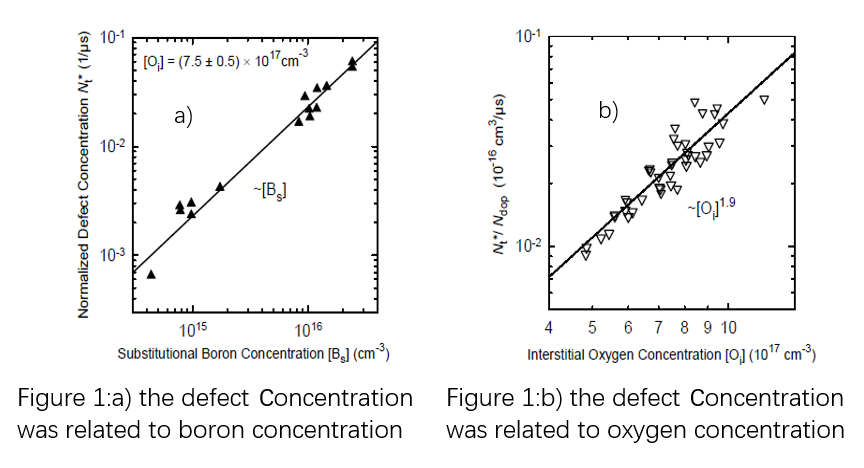
Schmidt carried out further research on the boron oxygen defect. It was found
that the defect concentration is directly proportional to the boron
concentration and squared to the interstitial oxygen concentration [3], as can
be seen in figure 1.?
Therefore, two
straightforward methods to eliminate the LID are either the reduction of
interstitial oxygen content or substitution of the boron by a different dopant
(e.g., by Gallium). Bianca from ISFH and Yichun Wang from LONGi [4] jointly carried
out research and found that Cz silicon with low oxygen content or Gallium
doping had a better anti-LID performance. However, PERC solar cells from industrial
Boron-doped Cz silicon with oxygen content of 12 ppm and 16 ppm degraded by
0.5% and 0.7% respectively, as can be seen in figure 2.
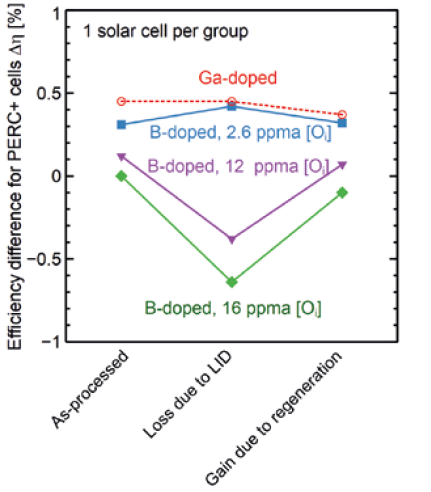
Figure
2. Efficiency differences for the PERC+
solar cells fabricated from the four different Cz-Si materials in the
as-processed state, as well as after illumination at room temperature and after
applying the regeneration treatment.
Fabricating industrial Boron-doped Cz silicon
with low oxygen content (e.g., 2.6 ppm) is very difficult. Technologically, it
can be achieved by magnetically-confined Czochralski (MCz) crystal growth. However,
due to the application of a strong magnetic field, machine costs are
significantly higher when compared to commonly used Cz pullers. Therefore,
using Gallium as a dopant becomes a feasible way to solve the LID problem.
Since the resistivity distribution of silicon wafers will affect the cell
efficiency, A. Metz studied the relationship between wafer resistivity and cell
efficiency [5] in figure 3.
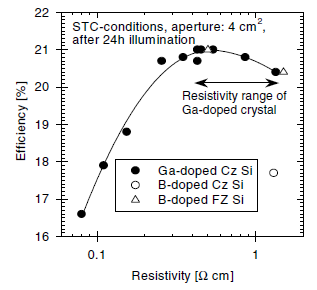
Figure 3. Cell efficiency obtained on
Gallium-doped Cz silicon as a function of base resistivity.
Peak efficiency of up to 21% has been achieved
on 0.4?cm material. In the
relatively broad resistivity range from 0.25 to 1.34?cm,
cell efficiency can reach more than 97% of the peak value, suggesting that the
resistivity of Gallium-doped silicon wafers should be based on this result in
order to achieve? maximum cell
efficiency.
In
recent years, light and elevated temperature induced degradation (LeTID) has
been observed in multicrystalline, float-zone and Cz silicon. It involves an
initial lifetime degradation, but typically recovers over time, with
degradation and recovery rates depending on thermal history. Nicholas E. Grant [6]
found that LeTID exists in both Gallium-doped and Boron-doped monocrystalline
silicon wafers (figure? 4.)
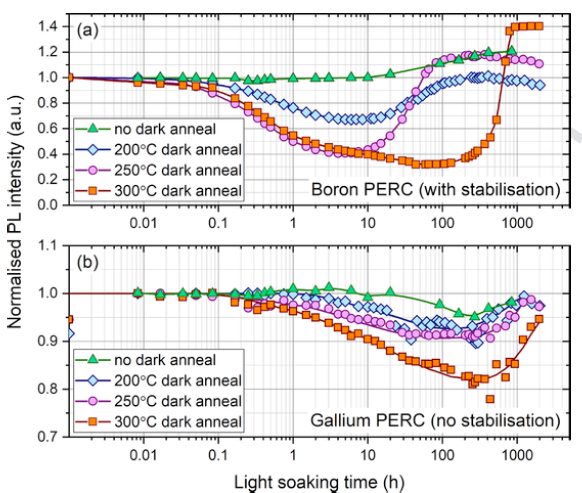
Figure 4. Normalized PL intensity of
Gallium-doped and Boron-doped substrates.
In the same annealing conditions, the
degradation of a Gallium-doped PERC cell is lower than that of a Boron-doped
equivalent. For further analysis of the bulk lifetime degradation of
Gallium-doped and Boron-doped silicon, eliminating the influence of? surface metallization of the silicon wafer, the
Gallium and Boron PERC cells were stripped and passivated by ALD Al2O3,
resulting in a complete change in?
degradation characteristics, with no degradation for Gallium and
boron-oxygen-like degradation for Boron in figure 5.
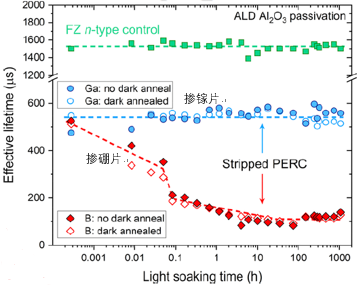
Figure 5. The degradation of a Gallium and
Boron PERC cell after stripping and passivation by ALD Al2O3.
According to a research report by the
University of New South Wales [7], LeTID is caused by a complex combination of
several metallic impurities and hydrogen. By controlling the concentration of
hydrogen, LeTID can be effectively inhibited. When using Gallium-doped silicon,
since there is no need to introduce too much hydrogen for passivating the boron
and oxygen defects, LeTID can be easily controlled.
3.The
basic property of LONGi’s Gallium-doped silicon wafer
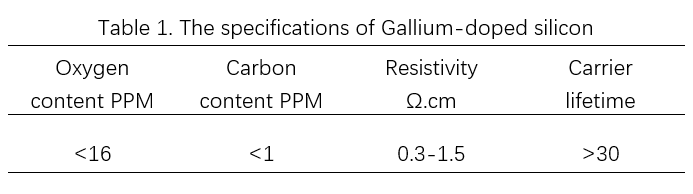
The specifications of LONGi’s Gallium-doped
silicon wafer are shown in table 1. All indexes in the table are tested
according to GB/T 25076-2018 《Monocrystalline
silicon wafer for solar cells》.
The
difficulty in application of Gallium-doped silicon wafers resides in the
control of resistivity compared with Boron-doped silicon, since there is a significant
difference between the segregation coefficient of Boron (0.75) and Gallium (0.008).
?LONGi’s R&D focuses on the
characteristics of Gallium-doped silicon, in order to achieve a reasonable
resistivity range and higher doping accuracy. The objective is to improve the
Gallium-doping process via an innovative model which controls the resistivity
range from 0.3 to 1.5 Ω.cm, which is almost the same as that for Boron-doped silicon.
LONGi can also provide corresponding resistivity products
according to customer demand, in which it is able to reduce the probability of different
brightness in EL images on cells. Moreover, the oxygen and carbon content and
carrier lifetime of LONGi’s Gallium-doped silicon wafers are basically the same
as for Boron-doped products.
Compared with a Boron-doped silicon wafer, Gallium-doped
silicon avoids the LID caused by a boron-oxygen defect. As long as the hydrogen
content in the cell production process is controlled,? LeTID can be inhibited and the total
degradation of both cell and module will be very low.
4.The
application of Gallium-doped silicon
LONGi’s Gallium-doped silicon wafer has been
verified by a number of cell manufacturers, its efficiency and anti-PID
performance showing an improvement when compared to a Boron-doped cell.
Table 2. The electrical property of LONGi’s Gallium-doped
and Boron-doped cell.
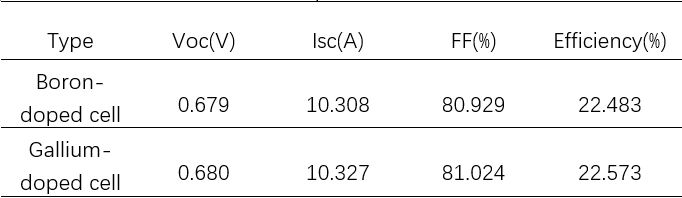
The test results for
LONGi cells are shown in table 2 and figure 6. The average efficiency of
Gallium-doped cells is 0.09% higher than that of Boron-doped equivalents.
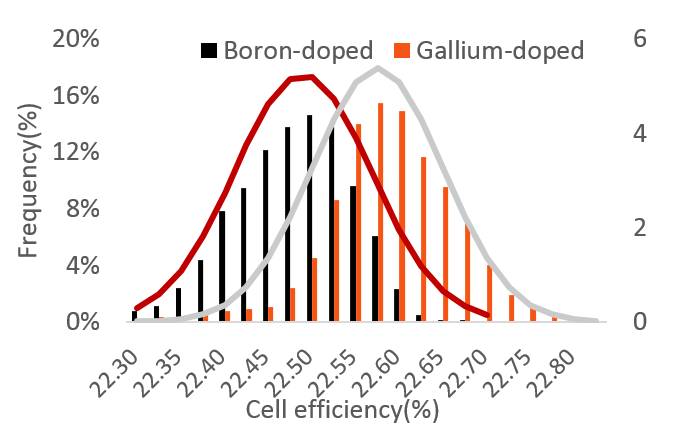
Figure
6. The efficiency distribution of Gallium-doped and Boron-doped cells.
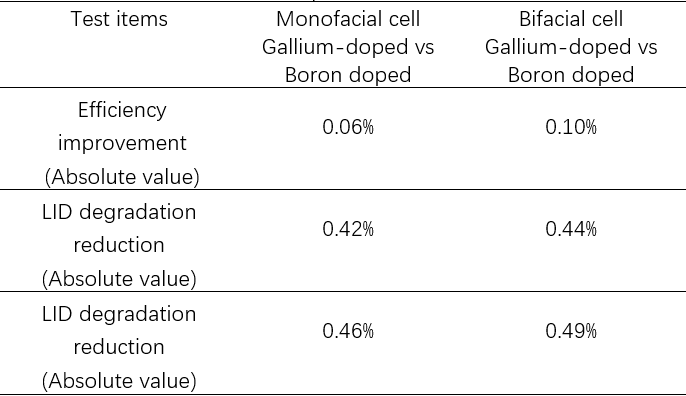
Aiko Solar
has carried out testing on Gallium and Boron-doped cells, including an efficiency
test where 5kWh LID (Irradiance is 900-1100W/ m2, test temperature
is 55-65°C) and CID
(110° 0.5A 8hours)�,�,�,as can be seen in table 3. It was
found that Gallium-doped cells had better anti-degradation performance than
Boron-doped equivalents.
Table 3.?
The test results of Aiko Solar’s Gallium-doped and Boron-doped cells.
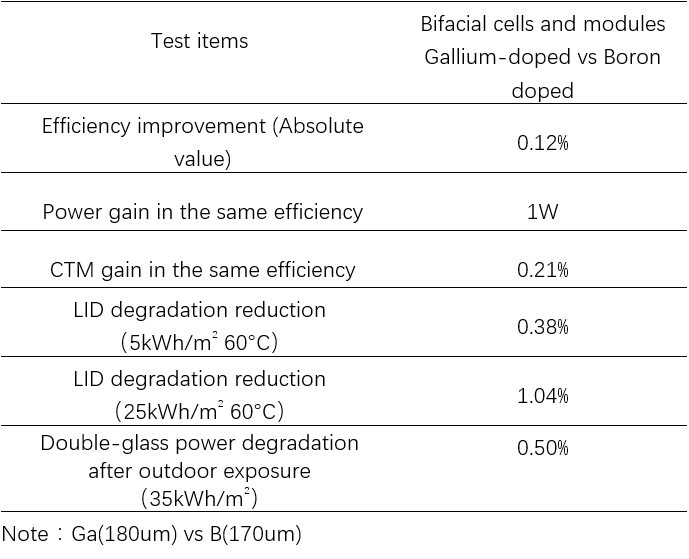
Chint
Global carried out further research on the relative performance of Gallium- and
Boron-doped cells and modules, as can be seen in table 4. The Gallium-doped
silicon wafer performed very well, both in cell and module applications. Cell
manufacturers do not require configuration of illumination or electrical
injection regeneration process equipment. From the quality control point of
view, this method of solving LID at the material side is more reliable than at the
process side (eg illumination and electrical regeneration process).
Table 4. The test results of Chint Global’s
Gallium-doped and Boron-doped cells. and modules.
5.Summary
In summary, Gallium-doped PERC cells have a higher
efficiency and better anti-LID and anti-LeTID performance compared with
Boron-doped cells. LONGi will promote its Gallium-doped silicon wafers for the
whole industry chain, making a significant contribution to a reduction in initial
module degradation, lowering equipment costs for cell manufacturers and increasing
profits for the whole PV industry.
References:
1.Fischer, H. & Pschunder, W.
1973, “Investigation of photon and thermal induced changes in silicon solar
cells”, Proc. 10th IEEE PVSC, Palo Alto, California, USA, p. 404
2.J. Schmidt, A.G. Aberle, and R.
Hezel, Proc. 26th IEEE Photovolt.
Spec. Conf. (IEEE, New York,1997), p. 13.
3.J. Schmidt, Physical Review B,
69(2004) 024107.
4.B. Lim, A. Merkle, R. Peibst, T. Dullweber, Y. Wang, R. Zhou, LID-free PERC+ cells with stable efficiencies up to 22.1%, in: Proc. 35th Europ. Photovolt. Solar Energy Conference, 2018, pp. 359–365.
5.A. Metz, J. Schmidt, A.G.
Aberle, and R. Hezel, Proc. 26th IEEE
Photovolt. Spec. Conf. (IEEE, New York,1997), p. 13.
6.Nicholas E. Grant, “Lifetime
instabilities in gallium doped monocrystalline PERC silicon solar cells”, Solar
Energy Materials and Solar Cells.
7.Daniel Chen, “A
Current Perspective on Light-and Elevated Temperature-Induced Degradation
(LeTID): Defect Mitigation, Models and Root Cause”, 15thChina SoG Silicon and
PV Power Conference.
 Global English