In
recent years, LONGi’s monocrystalline modules have been recognized by global
customers for their excellent performance and reliability, leading to
fast-growing shipments, industry-leading brand awareness and product
bankability. This article will reveal how the reliable quality of LONGi’s
modules is created from the aspects of product design, manufacturing and
testing.
1. Module Design
1.1 Design
and Simulation
LONGi’s
module design fully combines theoretical modelling, experimental results and
historical experience, comprehensively considering efficiency, power generation
capacity and reliability in various scenarios. LONGi’s product research and
development center has established optical, electrical and mechanical models
related to the design of photovoltaic modules, to carry out corresponding
simulation calculation at the initial stage of product design, and choose the solution
with the best comprehensive performance according to the results. In the fundamental
research into new photovoltaic materials, testing and analysis of photovoltaic
devices, product reliability and system integration, LONGi has forged an in-depth
research cooperation with scientific research institutions such as the
University of New South Wales in Australia to provide guidance for new product
development.
1.2 Material
Selection and Testing Standards
For the
selection of module materials, LONGi has always maintained a highly cautious approach,
usually preferring materials that have already been fully validated by the
industry. For new materials and corresponding processes, LONGi carries out more
rigorous evaluation and verification: first of all, it makes a theoretical
analysis of the material’s performance, based on its composition and structural
characteristics, followed by targeted and stringent tests. Finally, the module containing
the material must pass a reliability test to a level which is twice (or even 3
times) more demanding than the IEC standard, only being approved for use after its
successful completion.
In terms
of selection of its suppliers, LONGi insists on cooperating with organisations
with an industry-leading reputation and guarantee of long-term operations, to ensure
the stability and reliability of material performance. With a corporate culture
of being “reliable, value-added and fair”, LONGi advocates equality in dealing with
supply chain partners, a win-win cooperation and innovation to promote the
progress of both products and the industry in general.
1.3 Performance
Verification
In
addition to theoretical analysis and laboratory tests, the evaluation of the reliability
and power generation capacity of photovoltaic modules also needs to be
supported by outdoor test results. LONGi’s product research and development
center has a 200kW field test station for special research, such as energy gain
on the rear of bifacial modules in different application scenarios, light-induced
and medium and long-term degradation of modules, anti-PID performance, shading analysis,
analysis of working temperature and module hot spots. For research into the outdoor
field test performance of modules under various climatic conditions, LONGi has
successively cooperated with authoritative institutions including the China
Electric Institute, T?V S?D, T?V Rheinland, RETC, the China General
Certification Center and DNV GL, and set up field test power stations in
different locations around the world to fully verify performance under different
?conditions. These field test power
stations have obtained a great deal of valuable data and provided strong
support for the verification and analysis of the reliability of products and
materials.
2. Module Manufacturing
2.1 Comprehensive
Quality System and Quality Control
LONGi has
a comprehensive quality control system, and has obtained ISO 9001 and IEC TS
62941 certifications in the photovoltaic field. Quality management covers
processes such as supplier management, new product development, product change,
product production and test equipment measurement. With respect to production,
quality and equipment information are collected through the MES (Manufacturing Execution
System). The quality control of a factory is highly respected by customers and
third-party factory auditors.
2.2 Advanced
Manufacturing Capacity
LONGi’s
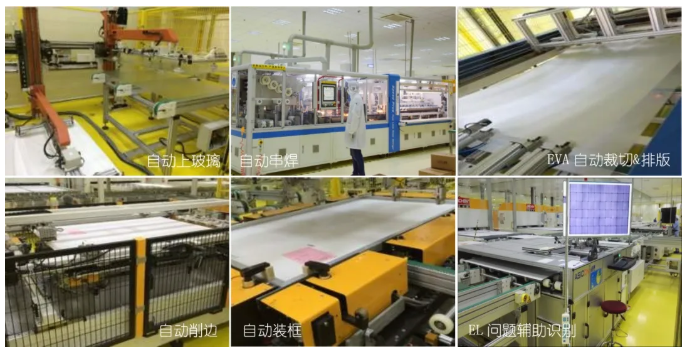
10GW-class cell and 20GW-class module capacity have both been built in recent
years and high levels of automation not only greatly improve production
efficiency, but also help to ensure the stability of the production process.
In
addition, compared with other manufacturers in the industry, LONGi has a better
product structure. At present, the mainstream products are the Hi-MO4 series
and the half-cell monofacial and bifacial modules based on M6 silicon wafers.
M2 half-cell modules will exit the market after delivery of existing orders. Unified
product specifications bring great convenience for material procurement, product
production and inventory management, and are also conducive to the optimization
of product quality.
2.3 Reliable
Supply
LONGi
has the largest module production capacity in the world, and can meet? client-side demand from its own capacity,
without the need for OEM. As a vertically integrated enterprise, LONGi adopts
only high-quality, low-degradation silicon wafers, which, when coupled with a
high level of in-house cell supply, guarantees module quality.
In line
with the “reliable” corporate culture, LONGi has always communicated openly
with customers on issues such as supply capacity and technical parameters
without making false promises. In the rush-to-install period with tight supply
in the industry over the years, LONGi has effectively supported customers to
put their projects, including “Top Runner” projects, on grid on schedule, and have
therefore earned their support and trust.
3. Reliability Testing
3.1 In-house
Reliability Testing
As
mentioned in 1.2, LONGi tests the reliability of new products according to 2~3
* IEC standard, and for the passing standard of 1 * IEC test, LONGi’s internal
control index is much stricter than the common degradation (< 5%) in the
industry. In addition, LONGi has established a variety of differentiated
reliability testing methods based on the research results of well-known
institutions and third-party bodies in the industry. Here are 3 examples:
A. HATC
(Highly Accelerated Thermal Cycling)
TC (Thermal
Cycling) testing is to verify the welding performance of products under certain
temperature changes. The analysis and study of the key influencing factors of a
TC test shows that increasing the maximum temperature (Tmax) of the test is
helpful to quickly evaluate the aging lifespan of products under thermal cycling.
Therefore, LONGi introduced HATC into the reliability test, increasing the Tmax
from 85 °C to 125 °C. The lifespan of a product assessed by HATC is 2.9 times that
of one assessed by IEC TC. HATC can not only evaluate the weldability of modules
more quickly, but also help to find?
failure risk points that cannot be identified in the conventional IEC
standard test. This is due to more stringent condition settings and ensures a
more comprehensive evaluation of product reliability.
B.
UV+DH Ageing
In the
IEC standard test, UV (ultraviolet) or DH (damp heat) tests are conducted
separately to evaluate the damp heat stability of the module, which is quite
different from the outdoor environment. When working in the corresponding area,
the module is not only in a damp heat environment, but is also subjected to
solar irradiation. In order to better and more strictly simulate the service
condition of module materials in an outdoor environment, LONGi introduces a UV+DH
ageing test. The UV and DH tests are carried out at the same time to evaluate
the long-term outdoor service of module materials, and represent a more stringent
and typical set of testing criteria.
C. Cell-side
Metal Corrosion Testing
According
to the degradation curve of a module in long-term outdoor service, the main
failure mode in the stable and later stage is power degradation caused by interior
cell metal corrosion, which is difficult to evaluate via the IEC standard test.
In order to assess the corrosion of cell metal more effectively and quickly, LONGi
carries out a cell-side electrochemical (positive and negative bias) corrosion
test in an acetic acid solution by simulating a DH or PID test connection mode
to verify the corrosion of cell surface metal, assess the possible corrosion
risk points of modules in long-term outdoor service, and design reliability to minimize
the outdoor metal corrosion risk and improve long-term reliability.
3.2 Third-party
Accredited Enterprise Lab
LONGi’s
Taizhou module test lab not only has CNAS certification, but also meets the ISO/IEC
17025:2017 standard criteria. It has also been certified by institutions
including the China Quality Certification Center (CQC), the China General
Certification Center (CGC), T?V Rheinland, T?V S?D, CSA and UL. Accurate
testing and measurement ensure the accuracy of the reliability analysis
conclusions.
3.3 Third-party
Evaluation of Module Quality
Over
the years, LONGi’s modules have achieved excellent results in third-party
testing and evaluation:
A. RETC
2019 (High Achievers in PV Module Index 2019 edition)
In
order to enter the US market, photovoltaic modules usually need to pass
stringent reliability tests higher than the IEC standard in laboratories
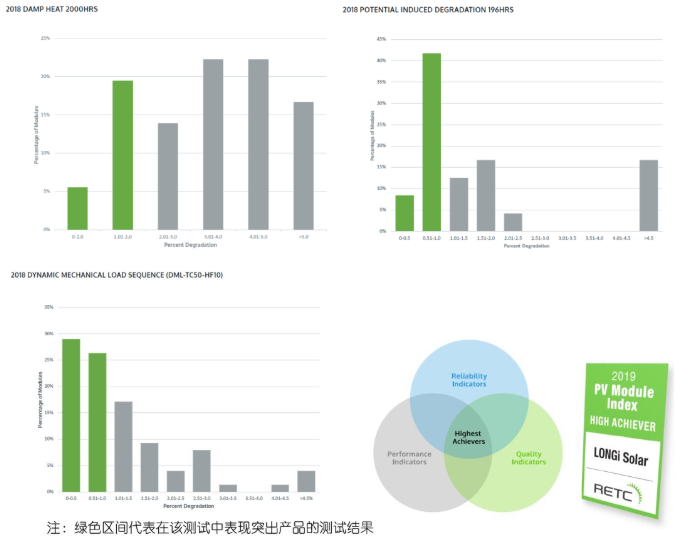
including RETC and PVEL. RETC (Renewable Energy Test Center) released their PV
Module Index report for the first time in 2019, based on the data of more than
2,500 crystal silicon and thin film modules from 46 companies tested in 2018. The
products of LONGi and Panasonic delivered an outstanding performance in the
evaluation of the three major indicators and won the high achievers award. The
tests involved in the evaluation included TC600, DH2000, HF30 (Humidity
Freeze), DML+TC50+HF30, PID196h; module efficiency, Pan File & energy yield
simulation and LID. LONGi’s modules performed well in all tests.
B. AON test
In
2018, Japan’s AON insurance company commissioned T?V Rheinland Japan to
evaluate the long-term reliability of LONGi’s single-glass modules. Testing included
HATC, stringent hot spot endurance and backplane endurance sequence testing
(DH800+UV60+TC200+static load). The subsequent report concluded that the annual
degradation of LONGi’s single-glass module is 0.31% / year, which is less than the
warranty value (0.55%).
C. T?V
Rheinland “All Quality Matters” award
T?V
Rheinland began to host “All Quality Matters” events at the end of 2016 to
evaluate photovoltaic products. Photovoltaic modules are selected from 1,000
mass produced modules for Pan file testing, simulating power generation in five
cities around the world (later adding outdoor power generation comparisons).
Among the three events organized from 2017 to 2019, LONGi won first place in energy
yield simulation in the monocrystalline group in 2017 and 2018 (the simulated energy
yield is more than 1.5% higher than the first place in the polycrystalline group),
and won first place in the monofacial group in the outdoor power generation field
test in 2019.
D. PV
Magazine test
The German
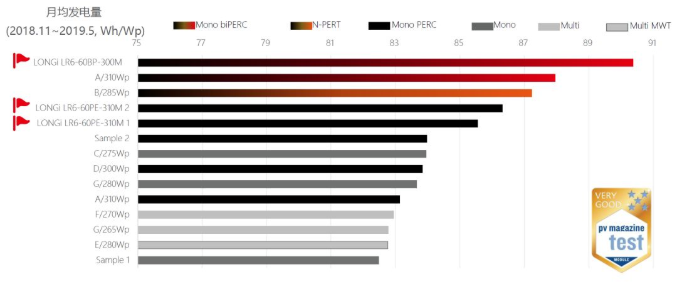
PV Magazine Group, in conjunction with the American CEA and Chinese Gsolar, took
samples from 2,000 modules to test their performance and carry out outdoor power
generation field testing. LONGi’s PERC monofacial and bifacial modules were
found to be far ahead of similar products in terms of energy yield, demonstrating
their excellent power generation capacity and anti-degradation performance.
A photovoltaic
project is an investment that lasts for more than 20 years, and reliable
products can bring long-term ROI for investors. Reliable products come from
reliable companies. In the process of its long-term operation and accumulation,
LONGi always gives priority to its financial health and enterprise robustness, maintaining
fast-growing shipments in many markets around the world. With reliable products
and leading technology, LONGi continues to create higher value returns for both
customers and partners.
Download the PDF whitepaper here:? https://bit.ly/3ctOG9yhttps://bit.ly/3ctOG9yhttps://bit.ly/3ctOG9y
 Global English