It
is generally recognized that half-cell technology reduces the working current
of a cell string, thereby also reducing the internal loss of a PV module and
improving the module’s power by more than one gear. Compared with a full cell module,
half-cell technology reduces the hotspot and working temperatures of the
module, significantly improving power generation performance and reliability
and offering better power generation performance under shadow or uneven
irradiation conditions.
The
analysis of the impact of half-cell technology on the power generation of
modules is mainly seen in the early research papers of the Fraunhofer Institute
and ISC, but rarely in the power generation analysis of commercial modules. In
order to better study the impact of half-cell technology on module power
generation,? LONGi and the China
Electrical Research Institute (hereinafter referred to as "CEI")
jointly conducted a one-year empirical study in Qionghai, Hainan.
The
demonstration power station was officially put into operation in June 2019.
This article will analyze the power generation data for more than half a year.
1.? Test Plan
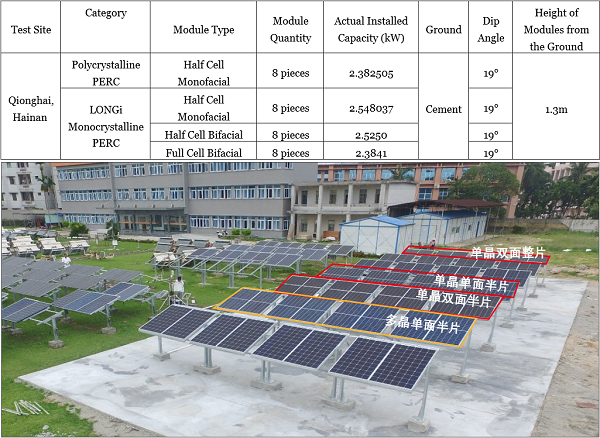
The
demonstration power station is equipped with monocrystalline and bifacial full-cell
modules, monocrystalline and bifacial half-cell modules and purchased
polycrystalline half-cell modules (PERC technology is adopted). All modules are
retested by the CEI in order to use the actual power for single Wp power
generation calculation. The details are as follows:
2. Power Generation Advantages
of Monocrystalline PERC over Polycrystalline PERC and Power Generation Gains of
Bifacial Modules
First
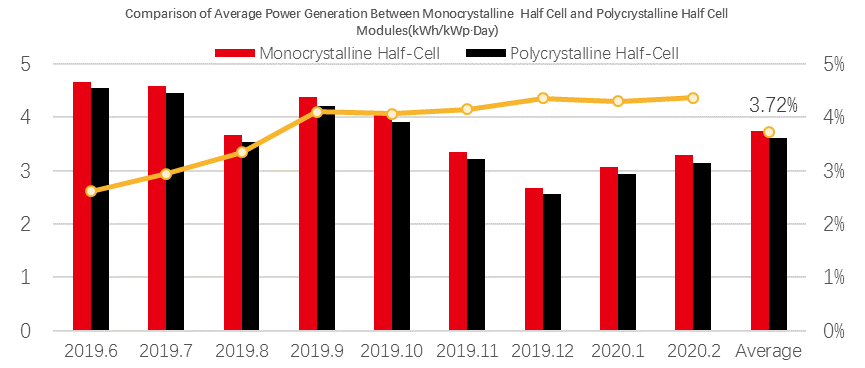
of all, the power generation difference between monocrystalline and
polycrystalline (PERC Monofacial) half-cell modules: in the 9-month statistical
period, the power generation gain of a monocrystalline half-cell module is about
3.72%, which shows that the monocrystalline module maintains the advantages of
low irradiance performance and power temperature coefficient when compared with
a polycrystalline module. The power generation gain increases month on month.
On the one hand, the advantage of winter irradiation is more obvious than that
of low and weak light. On the other hand, it should be related to the excellent
anti-LID performance of the LONGi module.
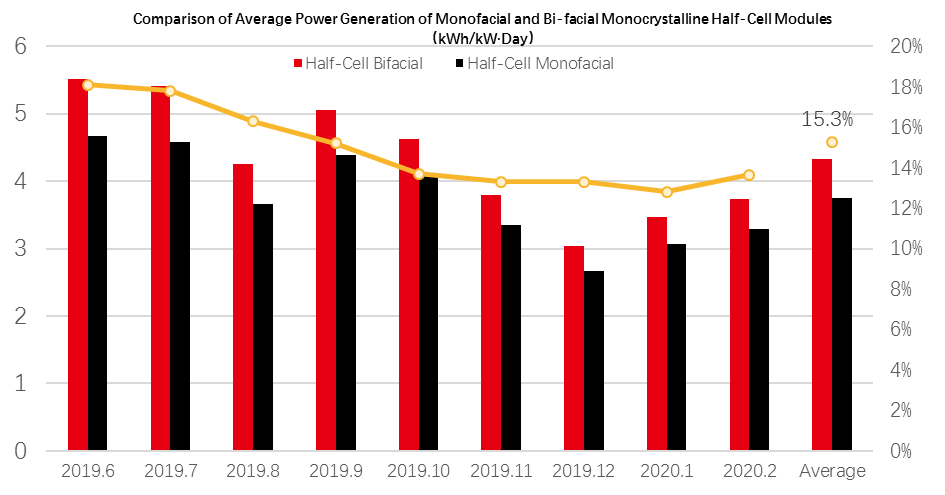
As
shown in the figure above, the power generation gain of a monocrystalline half-cell
bifacial module under cement surface conditions is 15.3%, compared with that of
a monocrystalline half-cell module over a period of 9 months, with the gain
meeting expectations.
3.? Analysis of the Influence of
Half-Cell Technology on Power Generation of a Bifacial Module
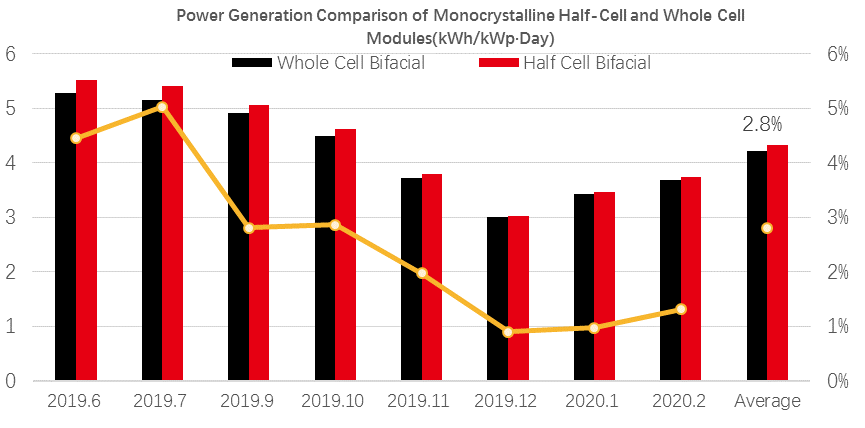
Due
to half-cell technology having the characteristics of reducing internal current
transmission loss of a module, the higher the irradiation, the higher the cell
string current, and the more the power generation loss is reduced by half-cell
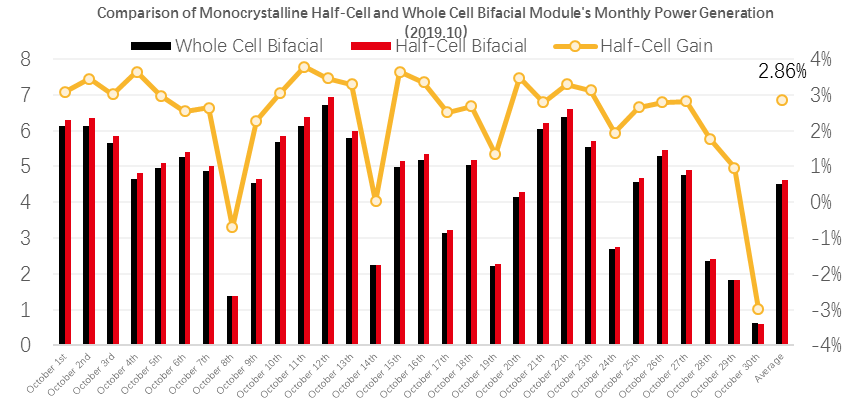
technology. As shown in the figure below, the average power generation gain of a
half-cell bifacial module is 2.8%, compared with that of a full-cell equivalent,
which obviously reflects the characteristics of high-power generation gain in a
month with good irradiation and low power generation gain in one with poor
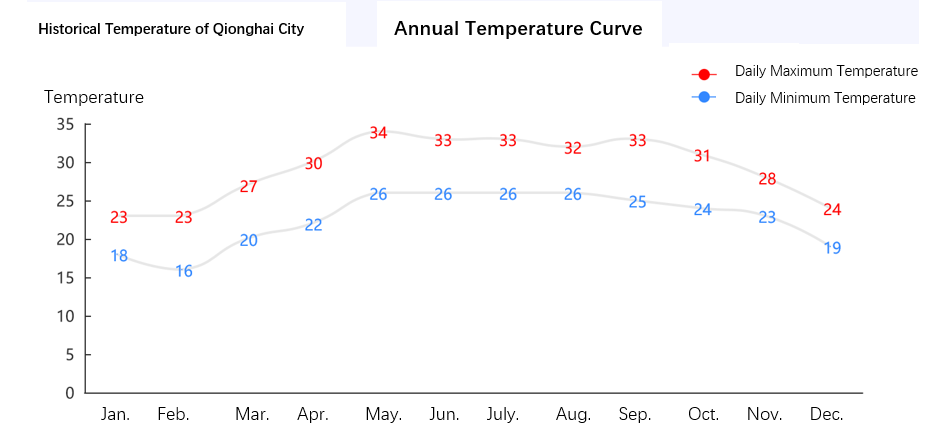
irradiation. The power generation gain in each month is positive. In addition
to irradiation, the higher temperature is also positively related to the power
generation gain of the half-cell module, the following figure listing the
monthly historical temperatures of Qionghai city as a reference.
It
can be seen from the statistics of a single month (October 2019) that the power
generation of the half-cell bifacial module is weaker than that of the full-cell
module due to irradiation differences on October 8 and 31, but power generation
gains on all other days are positive, gains being generally positive related to
the daily power generation.
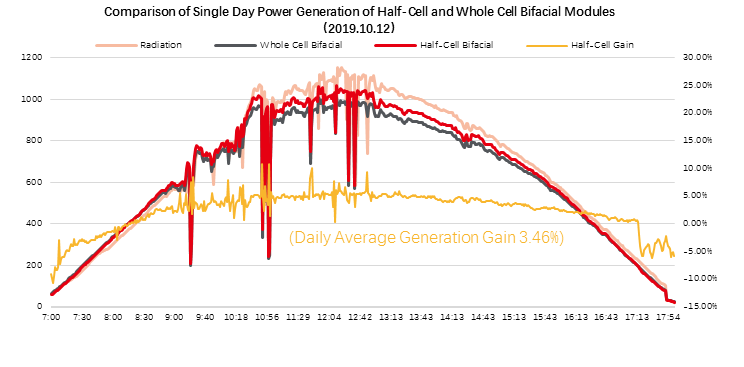
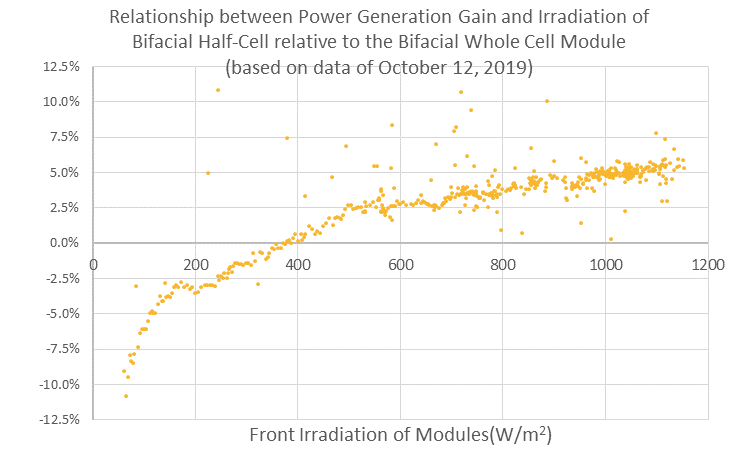
In
order to further study the effect of irradiation, we also compared the power
generation data of the single day of October 12. It can be seen that the power
generation of the half-cell bifacial and the full cell bifacial module is about
370W / m2 (corresponding to the ambient temperature of 27.2 ° C).
Considering the irradiation gain and bifacial ratio of the rear side, the
critical point of irradiation is about 400W / m2 . When the irradiation
is lower, the whole cell module has higher power generation capacity. The power
generation capacity of the half-cell module is relatively high when the
irradiation is over 1000W / m2 , the power generation advantage of
the half chip module being 5%.
The
empirical data for the Qionghai half-cell module from the CEI once again
confirms the power generation gain of the LONGi monocrystalline module relative
to the polycrystalline module and the bifacial gain brought by the bifacial
half-cell module. Compared with the bifacial full cell module, the half-cell equivalent
has an obvious power generation advantage in a high irradiation environment,
and it is clear that the critical irradiation value is about 400W / m2. The
high current of the monocrystalline PERC cell and the working current gain
brought by the light on the rear side of the bifacial cell make bifacial PERC
technology very suitable for combination with half-cell technology, which
brings multiple improvements in power capacity, power generation and
reliability.
 Global English